
Drag a generic "Add Noise" filter over a flat fill and you get a mathematically even dusting of dark and light, every pixel with the same odds of going either way, nothing clustering, nothing pointing anywhere. Now put a loupe on an old halftone separation and watch what real grain does: the dots clot and merge into solid mud down in the shadows, then break apart and scatter as they climb toward the highlights. Ink soaks into paper fibre unevenly. A burin catches and skips as it drags across copper at an inconsistent angle. Spray atomises into fine mist on one pass and heavy spatter on the next. Noise has become a slider, and most people leave it at that.
A trained eye clocks the fake from across the room, and so does a client who has stared at enough film grain to know it in their sleep. The tells are specific. Real grain has uneven density, heavier here and thinner there with no statistical fairness to it. It carries directionality, the record of a tool moving through a surface, so you can read which way the hand went. Under pressure it behaves like something physical, loading up and biting harder as you lean in, scaling its opacity in a tidy uniform ramp. And it survives a change of scale: it holds its character at thumbnail size in the Procreate interface and it still reads as grain blown up to a full print bleed, where a procedural scatter either turns to fuzz or disappears. Those four things separate a brush worth owning from a free forum giveaway that looks like the filter menu with extra steps.
Grain that came out of an etching plate
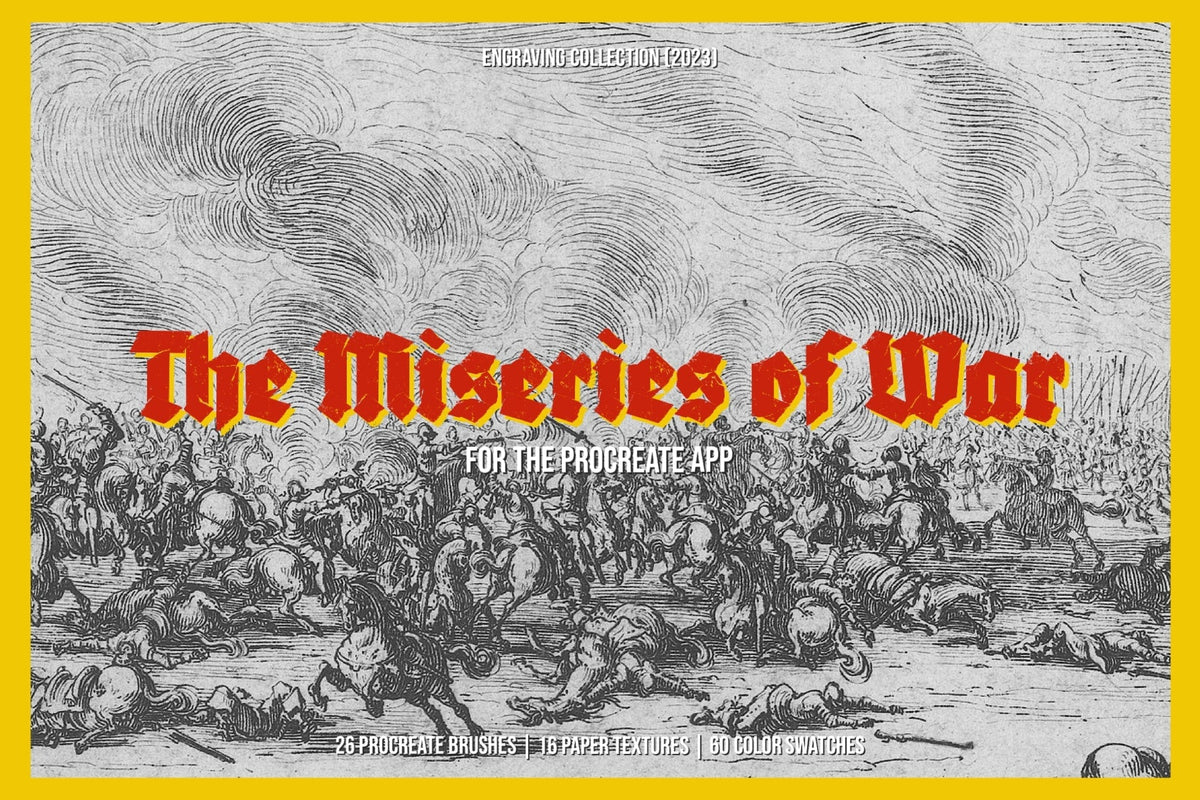
The oldest, most convincing grain on this list was cut into metal four centuries ago. Digi Life built The Miseries of War Procreate Kit directly from Jacques Callot's 1633 etching series, often called the first anti-war statement in European art, a run of panoramic scenes packed with tiny figures enlisting, fighting, looting and getting strung up. Callot's line work carries the gradation and the directional bite of a burin working a plate, and that is exactly the texture that survived the trip into Procreate. You get etching, hatching and cross-hatching that clusters and thins the way a real tool mark does, plus old paper and grunge to sit it on.

The companion set pulls from a sharper tongue. The William Hogarth Procreate Kit is built from the engravings of the English satirist who more or less invented the editorial cartoon, and it comes loaded: 24 brushes, 30 colour swatches and 10 paper textures delivered as PNGs at 2,550 x 3,300px and 500 DPI. That resolution matters for the scale test. Hatching and dotting sourced from a real engraving holds its structure when you push it up to print size, where generated line work smears. If you work in this territory regularly, our notes on vintage engraving for editorial and packaging go deeper on using it without it reading as clip art.

Grain built from the printing process itself
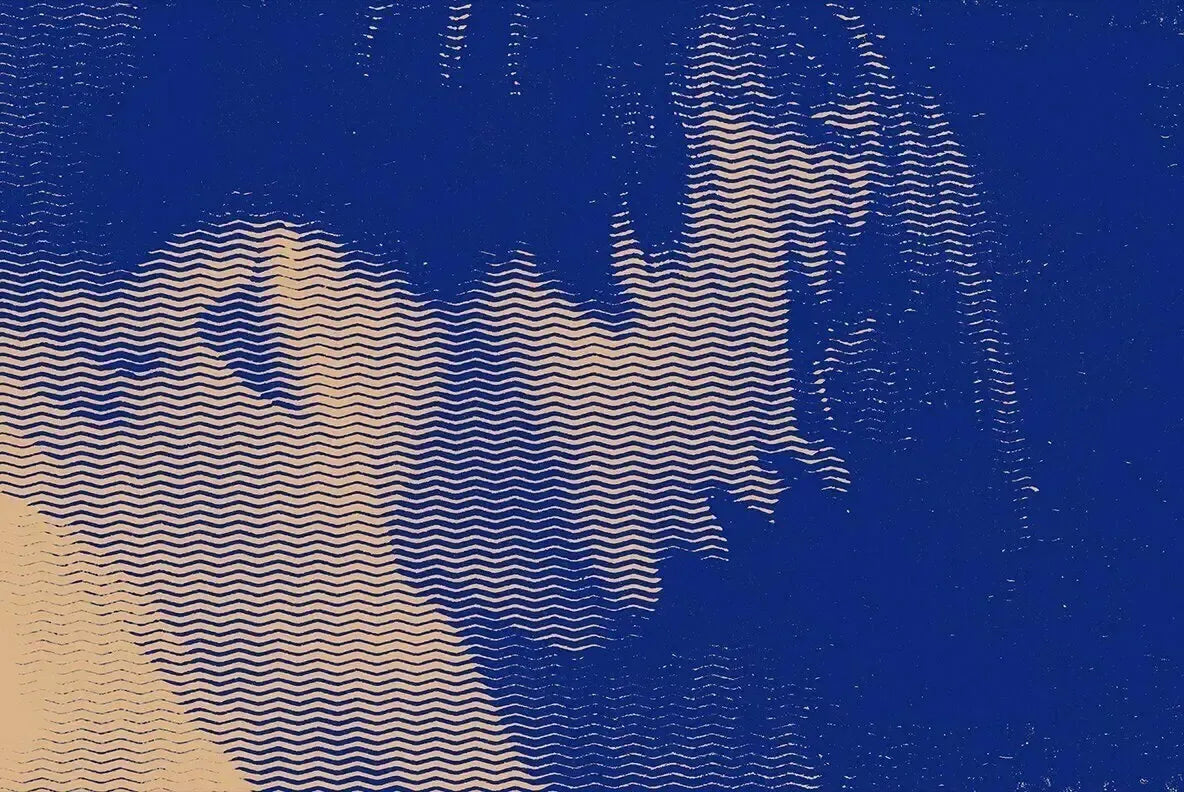
Halftone is where the slider-versus-surface gap gets brutal, because dot gain is a physical event and a flat procedural dot grid never fakes it. Pixelbuddha's Multi-App Printing Press Brush Studio is set up like running a small retro printing house, with 18 halftone patterns that reference 1960s newsprint, 1970s poster runs and 1980s children's book illustration, alongside stroke-and-grain brushes tuned to read as volume and motion, and paper texture to ground the whole thing. It travels across apps too, with texture JPGs for Illustrator among the formats, so it isn't locked to the iPad. For the mechanics of making dots clot and register like the real thing, there's our piece on faking registration and dot gain by hand.

Sko4 took a tighter brief. The Shading Procreate Brushes are 25 brushes built around grain shading, pressure sensitive so they load up as you lean in, and aimed at the working end of the job: grain overlays, drop shadows, speckle accents and bold grungy shading. This is the set you reach for when a flat illustration needs weight in the shadows, with speckle that clusters and clumps the way ink does on paper, never hovering as a smooth gradient.

Grain scanned straight off a physical material
Nothing carries the fingerprint of a process like a direct scan of that process happening. Sprayed Procreate Brushes by Tim Hankins Design were made from hi-res scans of real spray paint cans, which is why the atomisation reads right: fine mist in one zone, heavier deposit in another, the uneven fall-off you only get off an actual nozzle. The pack runs from fine drips and splatters to smooth lines and crisp edges, and it is pressure sensitive, so it answers to the hand. For streetwear and music merch it slots straight in; we pushed it further in our write-up on graffiti text effects with real spray can texture.

Paper has an edge no algorithm reproduces, which is the whole argument for Torn Paper Procreate Brushes by Creative Veila. Built natively inside Procreate, the set gives you 7 rip brushes for shaping natural torn edges, 16 stamp brushes and 6 paper texture brushes, with the fibrous unevenness of a real tear baked in. For collage, editorial layouts and anything leaning vintage, it beats drawing a jagged mask and hoping. There are plenty more textures to dig through if you want to keep building out the surface side of your kit.

Grain tuned for atmosphere
Sometimes you want the haze and you do not care where it came from, which is a legitimate call for album art and moody editorial. Misterio Shader Procreate Brushes by Pixelbuddha lean into atmosphere, with 15 noise brushes offering adjustable grain intensity and size plus 3 pressure-responsive shading brushes for smooth colour transitions and added volume. The whole thing is tuned for a warm, shadowy dark-academia feeling where the grain reads as mystery. Use it when the goal is pure atmosphere, grain that makes the viewer linger without clocking where it came from. If this is your lane, there's more where that came from.

You can trace the origin of a texture in its result the same way you can hear a room in a recording. Grain cut from a 1633 plate, pulled off a newsprint halftone, or scanned off a rattle can carries evidence of how it was made, and that evidence is exactly what a flat slider cannot manufacture. Pick the brush whose process matches the surface you are after, and the texture does the arguing for you.